
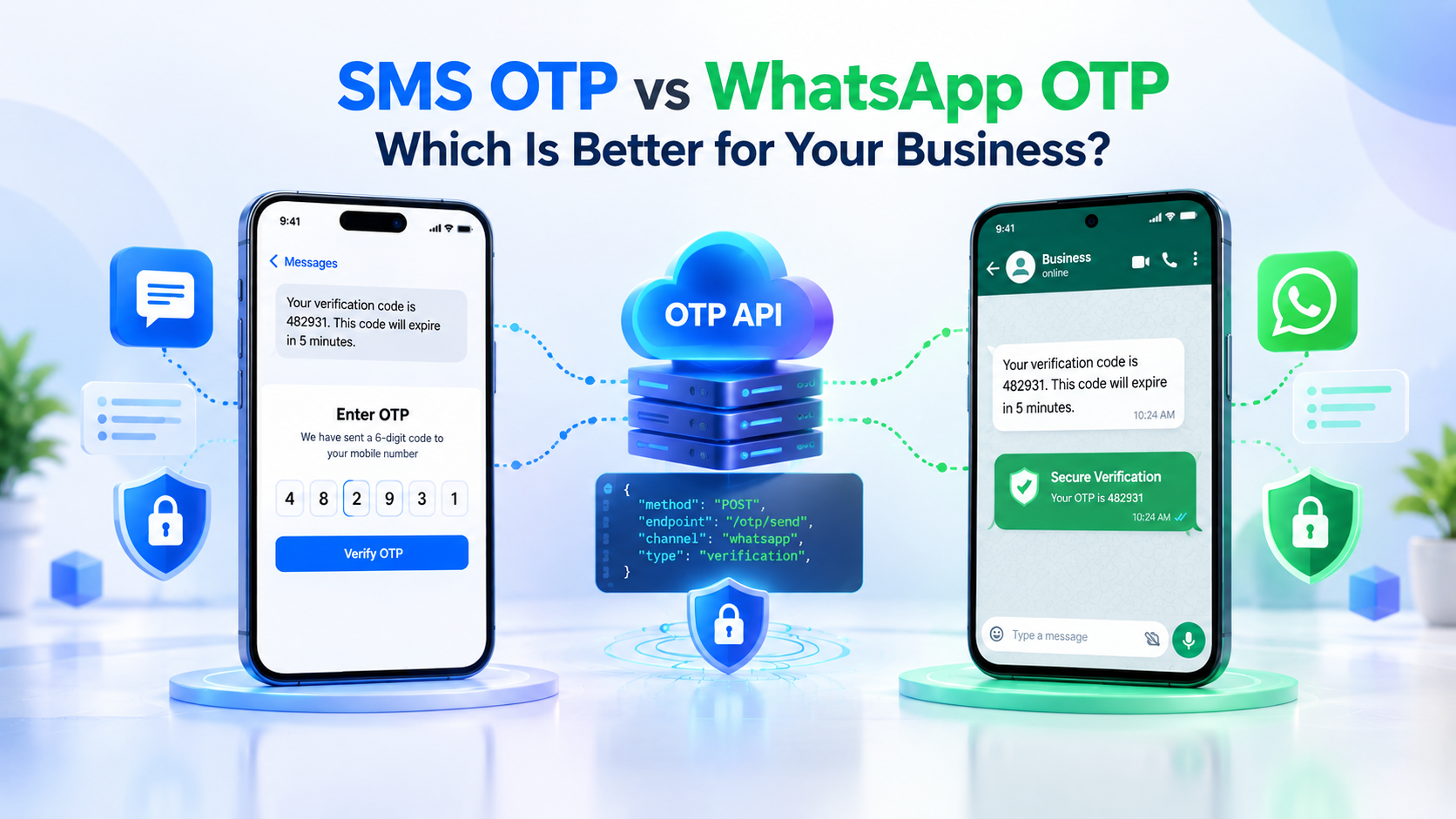
SMS OTP vs WhatsApp OTP: Which Is Better for Your Business?
When users create an account, log in to an application, reset a password, or verify their mobile number, businesses need a fast and reliable way to confirm their identity.
OTP (One-Time Password) verification is one of the most commonly used methods for securing these processes.
Traditionally, businesses have relied on SMS OTP to send verification codes to customers. However, with the growing popularity of WhatsApp, businesses can now use WhatsApp OTP as another verification channel.
So, which option is better for your business — SMS OTP or WhatsApp OTP?
The answer depends on your audience, application requirements, delivery needs, and preferred user experience.
In this guide, we will compare SMS OTP and WhatsApp OTP, explain how both work, and help you decide which solution is suitable for your website or mobile application.
What Is SMS OTP?
SMS OTP is a verification method where a temporary one-time password is sent to a customer's mobile number through SMS.
For example, when a user registers on a website, the application can generate a six-digit OTP and send it to the user's registered mobile number.
The user enters the OTP on the website or app, and the system verifies the code.
Common SMS OTP Use Cases
Businesses commonly use SMS OTP for:
- User registration
- Login verification
- Mobile number verification
- Password reset
- Account recovery
- Transaction verification
- Customer onboarding
- E-commerce verification
- App authentication
SMS OTP is especially useful because it does not require the customer to have a particular messaging application installed.
What Is WhatsApp OTP?
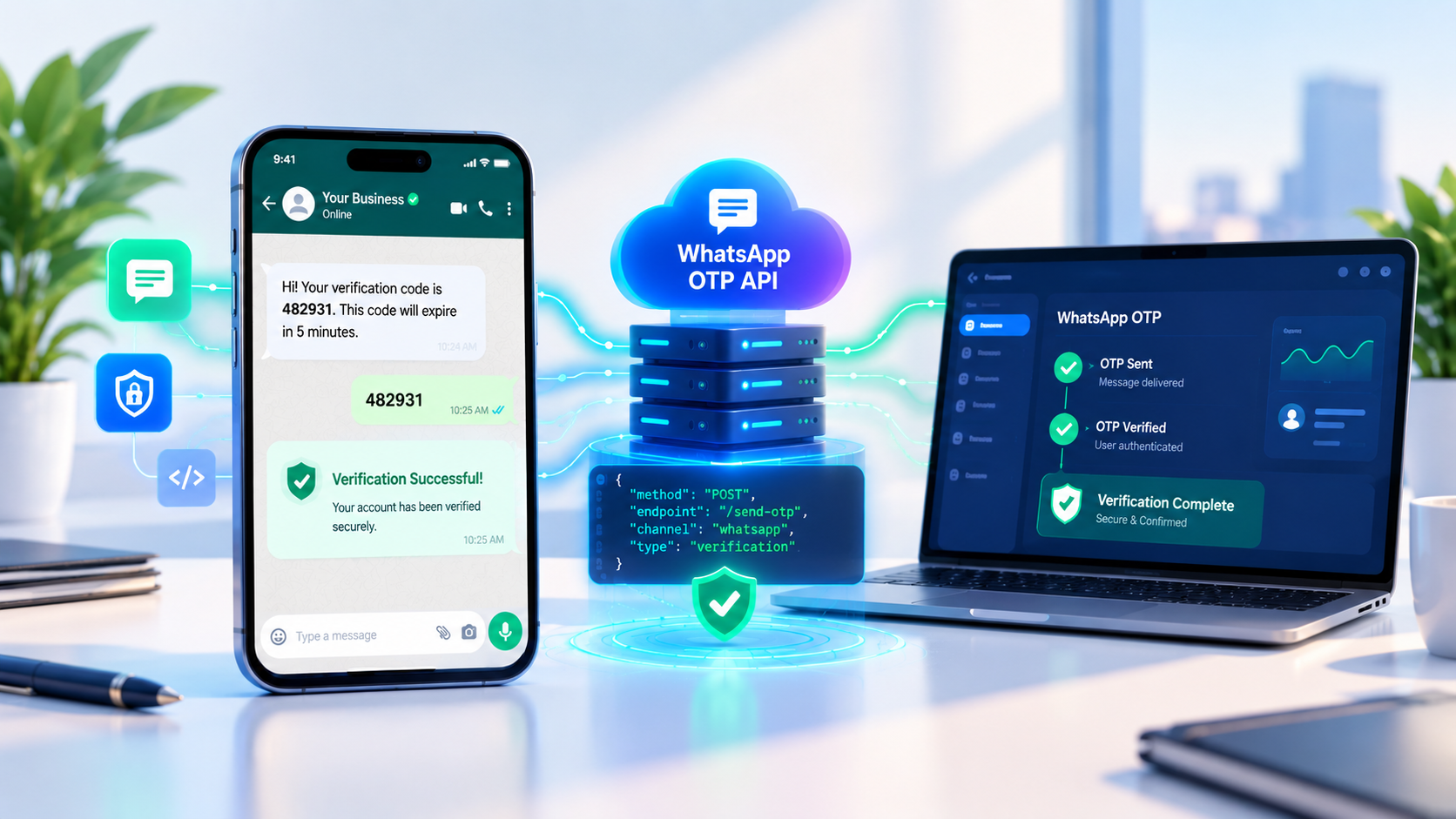
WhatsApp OTP allows businesses to send a one-time verification code through WhatsApp instead of traditional SMS.
The user receives the OTP inside a WhatsApp conversation and enters the code into the website or mobile application.
A WhatsApp OTP API can connect your application with the verification system and automate the process.
Common WhatsApp OTP Use Cases
WhatsApp OTP can be used for:
- Website registration
- Mobile app login
- Account verification
- Password recovery
- Customer onboarding
- Mobile number verification
- User authentication
- E-commerce account verification
For businesses whose customers actively use WhatsApp, this can provide a familiar and convenient verification experience.
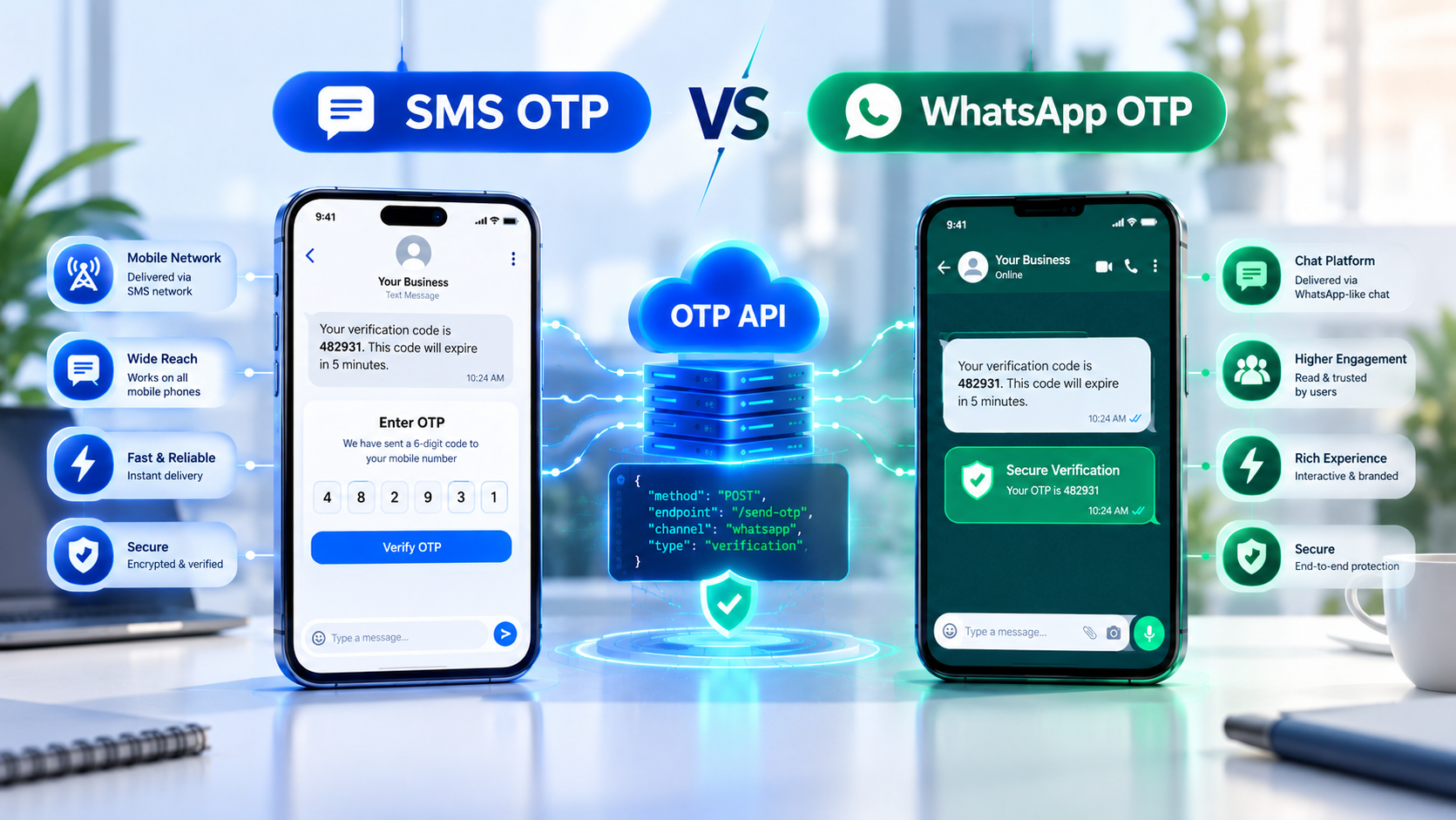
SMS OTP vs WhatsApp OTP: Key Differences
Although both methods are designed to verify users, the delivery channel and user experience are different.
| Feature | SMS OTP | WhatsApp OTP |
|---|---|---|
| Delivery Channel | SMS | |
| Requires WhatsApp | No | Yes |
| Mobile Number Required | Yes | Yes |
| API Integration | Yes | Yes |
| User Familiarity | Very High | Very High |
| Suitable for Apps | Yes | Yes |
| Suitable for Websites | Yes | Yes |
| Interactive Messaging | Limited | More flexible |
| Branding Opportunities | Limited | Greater possibilities |
| Backup Channel | Can be used as fallback | Can complement SMS |
1. SMS OTP Works Across a Wider Audience
One of the biggest advantages of SMS OTP is its broad accessibility.
A customer does not need WhatsApp to receive an SMS OTP. If the user has a mobile number and network connectivity, the OTP can be delivered through SMS.
This makes SMS OTP a practical choice for businesses with a diverse customer base.
For example, an e-commerce company serving customers across different locations may prefer SMS OTP as a primary verification method.
2. WhatsApp OTP Offers a Familiar User Experience
WhatsApp is widely used for everyday communication.
Because customers are already familiar with WhatsApp, receiving an OTP through the platform can feel natural and convenient.
Instead of switching between an application and their SMS inbox, users can receive the verification message directly in WhatsApp.
This can make the authentication process easier for businesses targeting WhatsApp-active customers.
3. SMS OTP Is Useful as a Universal Verification Channel
SMS remains an important authentication channel because it is not dependent on a specific messaging application.
For businesses where maximum reach is important, SMS OTP can be a strong option.
It can be integrated into:
- Mobile applications
- Websites
- Customer portals
- E-commerce platforms
- SaaS applications
- Registration systems
- Login systems
4. WhatsApp OTP Can Complement SMS OTP
Businesses do not necessarily have to choose only one option.
A more flexible authentication strategy can use multiple channels depending on the customer's situation.
For example:
Website/App → OTP Request → WhatsApp OTP → Verification
If WhatsApp verification is not suitable or available, businesses may consider an appropriate alternative channel such as SMS, subject to applicable provider and telecom requirements.
This type of multi-channel approach can help businesses create a more flexible verification experience.
5. Which Is More Suitable for Mobile Apps?
Both SMS OTP and WhatsApp OTP can be integrated with mobile applications.
For example, a mobile application can use OTP verification during:
Registration → Enter Mobile Number → Send OTP → Verify OTP → Account Created
SMS OTP is useful when the business wants broad mobile-number coverage.
WhatsApp OTP can be attractive when the target audience is highly active on WhatsApp and the business wants to provide verification through a familiar messaging platform.
6. Which Is Better for Websites?
Both options can work effectively for websites.
An e-commerce website, SaaS platform, recharge application, booking platform, or customer portal can integrate an OTP API into its registration and login process.
For example:
User enters mobile number → OTP API → OTP delivered → User enters OTP → Verification successful
The important factor is not simply choosing SMS or WhatsApp. Businesses should also consider:
- Delivery reliability
- API response time
- Security
- Scalability
- Integration quality
- Provider support
- Pricing
- Compliance requirements
7. SMS OTP vs WhatsApp OTP: Cost Considerations
The cost of OTP delivery depends on the provider, messaging route, country, message type, volume, and applicable platform or telecom charges.
Therefore, businesses should not choose a solution based only on the advertised per-message price.
Before selecting an OTP API provider, compare:
- Message pricing
- API charges
- Minimum purchase requirements
- WhatsApp-related charges
- SMS-related charges
- Delivery success rates
- Support
- Account validity
- Volume discounts
The cheapest option is not always the most suitable option for a production application.
8. Security Considerations
OTP verification is an important part of account security.
Whether you use SMS OTP or WhatsApp OTP, your implementation should follow basic security practices.
Recommended practices include:
- Use short-lived OTPs
- Never store OTPs in plain text unnecessarily
- Limit OTP verification attempts
- Implement rate limiting
- Prevent OTP brute-force attacks
- Use HTTPS for API communication
- Avoid exposing OTPs in application logs
- Add expiration times
- Monitor suspicious verification activity
Businesses should also review the provider's security and privacy practices before sending authentication information through a third-party API.
9. Which One Should Your Business Choose?
There is no universal answer.
Your choice should depend on your customers and application.
Choose SMS OTP when:
- You want broad mobile-number reach.
- Your users may not use WhatsApp.
- You need a traditional OTP verification channel.
- Your application is designed for a wide customer base.
- You want SMS as an authentication or fallback channel.
Consider WhatsApp OTP when:
- Your customers actively use WhatsApp.
- You want OTP delivery through WhatsApp.
- You want a familiar messaging experience.
- Your application already uses WhatsApp communication.
- You want to build a broader WhatsApp-based customer communication strategy.
Consider Both When:
Your application has a large customer base and you want more than one verification channel.
A multi-channel strategy can provide businesses with greater flexibility while improving the overall authentication experience.
How an OTP API Simplifies Integration
Instead of manually developing an entire OTP delivery system, businesses can integrate an OTP API into their website or mobile application.
A typical workflow looks like this:
User → Website/App → OTP API → SMS or WhatsApp → User → OTP Verification → Account Access
The API can handle important parts of the OTP workflow, including sending verification requests and processing verification responses.
This makes it easier for developers to add OTP functionality without building the entire messaging infrastructure from scratch.
Why Businesses Need a Reliable OTP Provider
OTP is often the first security interaction a customer has with an application.
If the OTP arrives late, fails to arrive, or the verification process does not work properly, the customer may abandon the registration or login process.
Therefore, businesses should evaluate an OTP provider based on:
Reliability + Delivery + Security + API Quality + Support + Scalability
A good OTP infrastructure should be capable of supporting both small applications and growing businesses.
SMS OTP or WhatsApp OTP: Final Verdict
So, SMS OTP vs WhatsApp OTP — which is better?
The answer depends on your business requirements.
SMS OTP remains a practical choice when broad mobile-number accessibility is important.
WhatsApp OTP can be a convenient option for businesses whose customers actively use WhatsApp and prefer receiving verification messages through the platform.
For many modern businesses, the best approach may be to support multiple verification channels rather than depending entirely on one.
If you are building a website, mobile application, e-commerce platform, SaaS product, or customer portal, choosing the right OTP API can make your authentication process faster, easier, and more reliable.
Frequently Asked Questions
Is SMS OTP better than WhatsApp OTP?
Not necessarily. SMS OTP offers broad accessibility, while WhatsApp OTP can provide a convenient experience for WhatsApp users. The right option depends on your target audience and application.
Can I use both SMS OTP and WhatsApp OTP?
Yes, businesses can design their authentication system to support multiple messaging channels, depending on provider capabilities and applicable requirements.
Can SMS OTP be integrated with a website?
Yes. An SMS OTP API can be integrated into websites for registration, login, mobile verification, password recovery, and other authentication workflows.
Can WhatsApp OTP be integrated with a mobile app?
Yes. A WhatsApp OTP API can be integrated into mobile applications to provide WhatsApp-based verification, subject to the relevant WhatsApp Business/API requirements.
What should I check before choosing an OTP API provider?
Consider delivery reliability, API documentation, security, pricing, scalability, customer support, data handling, and applicable regulatory/platform requirements.
Final Takeaway
SMS OTP and WhatsApp OTP are both valuable tools for modern user verification.
Instead of asking which technology is universally better, businesses should ask:
“Which OTP channel provides the best experience for my customers and application?”
With the right OTP API, businesses can simplify user verification, improve the login and registration experience, and build a more reliable authentication system for websites and mobile applications.
For businesses looking for flexible OTP and messaging solutions, meraotp.com provides options for SMS OTP and WhatsApp-based OTP services, along with additional messaging solutions such as RCS and WhatsApp communication.